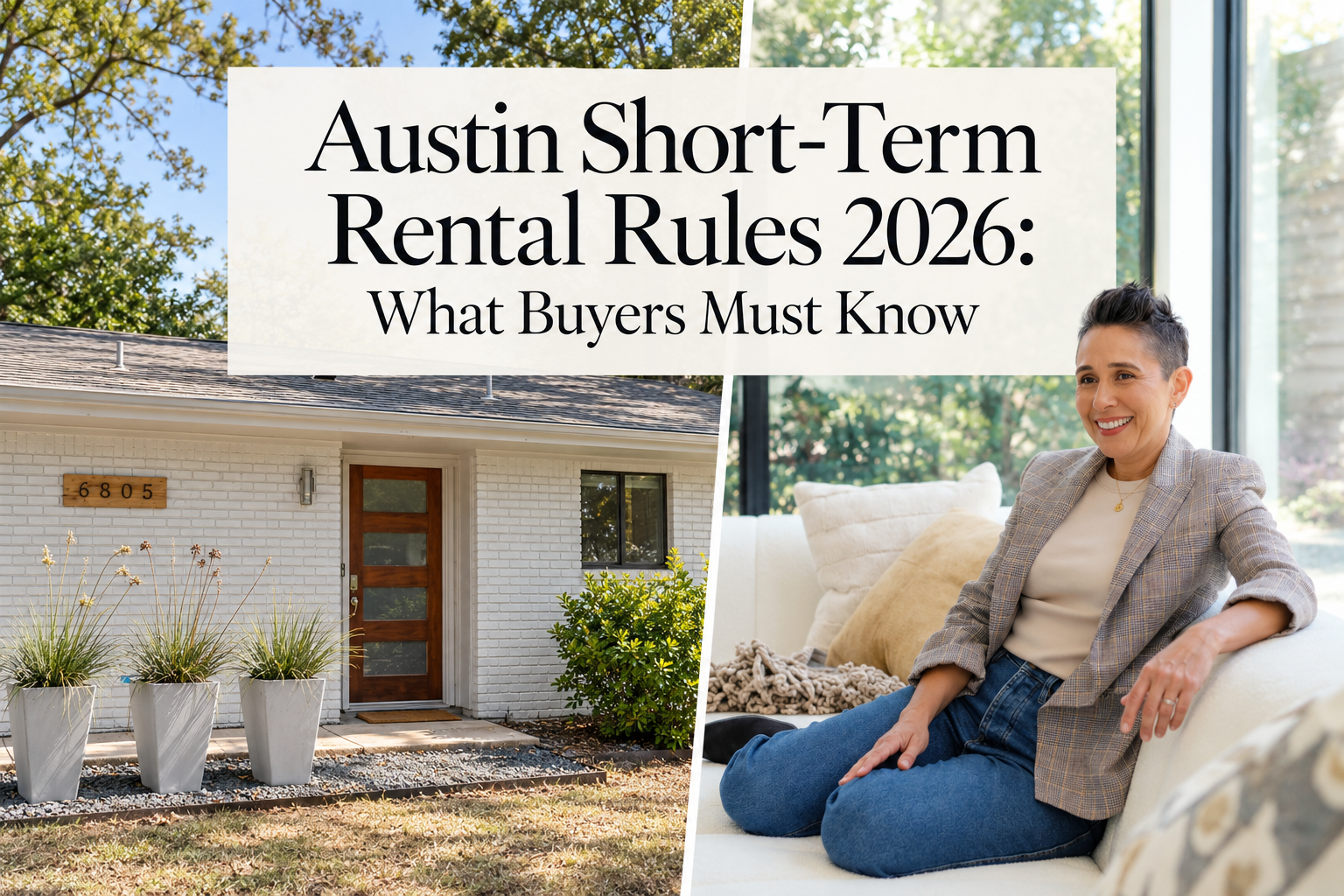
What are Austin’s short-term rental rules in 2026?
Updated October 2026
Every property rented out for less than 30 consecutive days in Austin needs a City of Austin short-term rental (STR) license, and as of July 1, 2026, Airbnb and VRBO are required to delist any property that doesn’t display a valid license number. There are three license types (Type 1 for owner-occupied homes, Type 2 for non-owner-occupied investment properties, and Type 3 for non-owner-occupied properties in restricted overlay zones), and new applications are currently taking 8 to 10 weeks to process. If you’re buying a property to run as an Airbnb or selling one that already operates that way, the license doesn’t transfer automatically, and your HOA may have its own rules that override the city’s entirely.
As of this spring, the city’s enforcement software had flagged nearly 2,800 of Austin’s roughly 9,300 active short-term rental listings as apparently unlicensed, and that was before Airbnb and VRBO were even required to start pulling unlicensed properties down. Enforcement has only gotten more serious since. If you’re shopping for a property with Airbnb income in mind, or you own one and you’re thinking about selling, the licensing picture is no longer something you can sort out after closing. It needs to be part of your due diligence before you write an offer.
The three license types, and why the difference matters
Austin splits short-term rental licenses into three categories, and which one applies to a property changes what you can do with it.
Type 1 (owner-occupied) covers your primary residence. You can rent out the whole house while you’re traveling, or just a room while you’re living there, with no annual cap on the number of nights. You’ll need to show it’s actually your primary residence, usually with a homestead exemption, voter registration, driver’s license, or utility bills in your name. Type 1 licenses are available in virtually all of Austin’s residential zones.
Type 2 (non-owner-occupied) is the investment property license, for a house or condo you rent out short-term but don’t live in. It comes with more conditions: a floor plan and site plan, safety documentation, notice to neighbors, HOA approval if the property has one, and a rule that the same owner can’t hold two Type 2 licenses within 1,000 feet of each other. Type 2 is also prohibited outright in certain single-family zones, including parts of East Austin and South Congress, under a City Council resolution that’s been in place since 2020.
Type 3 (non-owner-occupied, overlay zone) functions like a Type 2 but sits in a neighborhood with extra restrictions layered on top, which means an additional round of review from the city’s planning department before approval.
If you’re evaluating a property for investment income, the zoning determines which license is even possible there, not the other way around. That’s a question to answer before you fall in love with a listing’s projected nightly rate.
Why this matters if you’re buying for rental income
A seller telling you a property “does great on Airbnb” tells you nothing about whether that income survives the sale. STR licenses are tied to the property and the current owner, not the building itself. When ownership changes hands, the new owner has to apply fresh, and with processing running 8 to 10 weeks right now, that’s two months of a property sitting empty if you were counting on day-one rental income to cover the mortgage.
It’s also worth checking who else owns short-term rentals nearby. If you’re building a small portfolio, the 1,000-foot rule on Type 2 licenses means you can’t just buy up adjacent properties and run them all as nightly rentals under your name.
Then there’s the HOA layer, which can override everything the city allows. Several of Austin’s master-planned communities and condo associations prohibit short-term rentals entirely in their deed restrictions, regardless of what license type the city would approve, including communities like Steiner Ranch, Rough Hollow, Barton Creek, and the Domain’s condo buildings. HOA fines for violating these rules can run up to $200 a day on top of anything the city assesses. Before you write an offer on a property you’re planning to run nightly, pull the CC&Rs and confirm short-term rentals are actually allowed, not just assumed.
Why this matters if you’re selling a current short-term rental
If you’ve been running your property as an Airbnb and you’re getting ready to list it, your licensing status becomes part of the conversation with buyers, their lenders, and your title company. An unlicensed listing isn’t a quiet problem anymore. It risks fines of up to $500 a day for the operator, and the rule doesn’t require proving you knew you were out of compliance. Ignorance isn’t a defense.
Unlicensed operation can also affect your insurance. Standard homeowners policies typically don’t cover short-term rental activity, and running one without the right coverage or license in place can leave a claim unpaid right when you need it most, or complicate how a buyer’s lender views the property’s history.
Be upfront with buyers about your license type and status, and don’t assume they can simply step into your license. They can’t. If you want to help your buyer keep the rental income stream going, giving them a head start on their own application (floor plans, safety documentation, and the rest) can shorten that 8 to 10 week gap considerably.
Austin’s short-term rental rules changed the math on buying or selling an investment property here, and the details depend entirely on the specific zone, HOA, and license type involved. That’s exactly the kind of diligence we run with clients before they write an offer or list a rental property, because the wrong assumption here can cost two months of vacancy or an HOA dispute you didn’t see coming.
Frequently Asked Questions
Do I need a license to run an Airbnb in Austin in 2026?
Yes. Every property rented for less than 30 consecutive days needs a City of Austin short-term rental license, and since July 1, 2026, Airbnb and VRBO are required to remove any listing that doesn’t display a valid license number.
How long does it take to get an Austin short-term rental license?
Processing is currently running 8 to 10 weeks due to staffing constraints at the city. If you’re buying a property and counting on rental income right away, build that gap into your budget.
Can I take over the previous owner’s short-term rental license when I buy a property?
No. Licenses are tied to the specific owner and address, so a new owner has to submit their own application from scratch. The license doesn’t transfer with the sale, even if the rental has been operating for years.
What’s the difference between a Type 1 and Type 2 license in Austin?
Type 1 is for your primary residence and has no cap on rental nights. Type 2 is for investment properties you don’t live in, comes with more documentation requirements, is banned in certain single-family zones, and limits one owner to one Type 2 license per 1,000 feet.
Can my HOA stop me from running a short-term rental even if I have a city license?
Yes. A city license doesn’t override your HOA’s deed restrictions. Several Austin communities, including Steiner Ranch, Rough Hollow, Barton Creek, and Domain condo buildings, prohibit short-term rentals outright, and HOA fines for violating that can add up fast.
If you’re weighing a purchase for rental income, or you’re ready to sell a property that’s been running as a short-term rental, we’d love to help you think it through. Reach out anytime at munozaustin.com/connect.