Living in Mueller, Austin, TX: The Honest Neighborhood Guide
Mueller is the most successful piece of urban planning Austin has done in the last
fifty years, and it is genuinely not for everyone. It is roughly 700 acres of
walkable, mixed-use, mixed-income neighborhood built on the runways of the city’s old
airport, three miles from downtown and two from UT. It is also a place where a
committee approves new construction, the trees are young by definition, and you buy
walkability with yard space.
This guide covers what Mueller is, how it got built, what living there actually
costs you beyond the price, and who tends to be unhappy there.
Where is Mueller and what was it before?
Mueller sits three miles from downtown Austin and two miles from the University of
Texas, on the site of the former Robert Mueller Municipal Airport. The airport opened
in October 1930 and was named for Robert Mueller, a city commissioner who had died
three years earlier. It served as Austin’s airport until 1999.
The redevelopment was not fast and it was not developer-led. The vision came out of
the 1984 Citizens for Airport Relocation plan, which called for a “new town in-town.”
The City adopted the reuse and redevelopment plan in 2000 and selected Catellus as
master developer in 2002. The first family moved into a yard home on Emma Long Street
in 2007. Lake Park and the Southwest Greenway opened in 2008, H-E-B and the Thinkery
in 2013, Aldrich Street’s first restaurants in 2017.
The street names are worth noticing. Where nearby University Hills named its
streets after colleges, Mueller named its after Austin people. Emma Long was the
city’s first woman council member.
What kinds of homes does Mueller have?
More types than most people expect, and the type matters more than the square
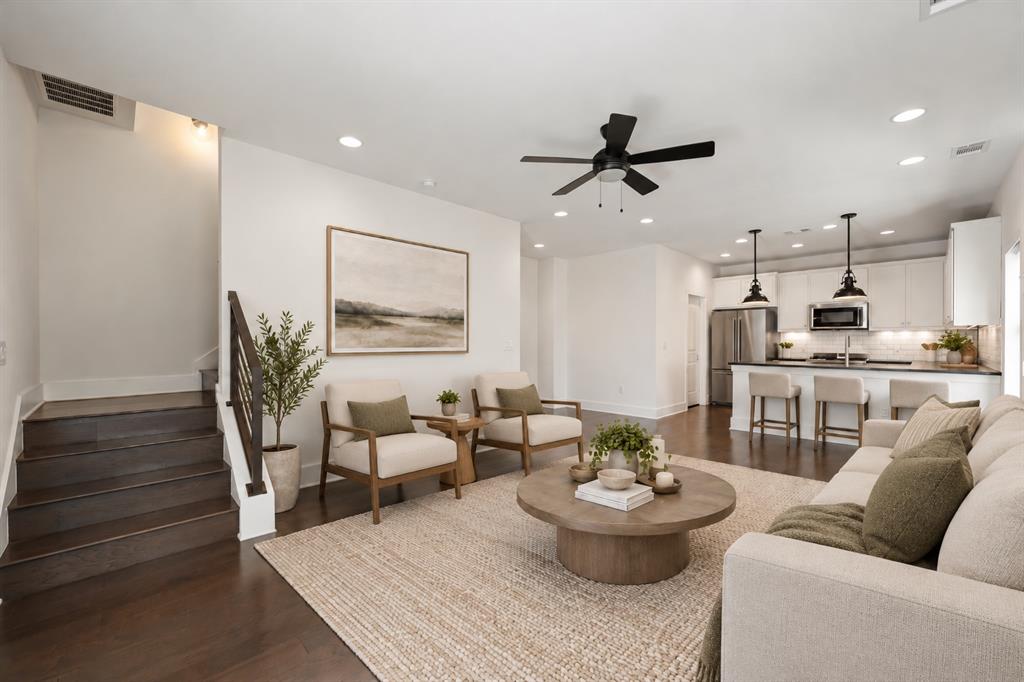
footage. Mueller has detached yard homes on 37-foot and 45-foot lots, attached row
homes facing shared courtyards, garden homes clustered around common landscaping,
traditional condos, Mueller House condos that put four or six units inside a building
designed to read as one large single-family house, and live-work Shop Houses.
Twenty-five percent of both for-sale and for-rent residences are part of the Mueller
Affordable Homes Program, administered with the Mueller Foundation. That mixed-income
requirement was built into the plan from the beginning and is the reason Mueller looks
demographically different from most master-planned communities.
What do people love about living in Mueller?
Four things, consistently.
Parks. Around 140 acres of them. Lake Park is 30 acres with a lake,
trails, and an open-air amphitheater. Add the Southwest Greenway, Branch Park, John
Gaines Park and Swim Center, Girard Kinney Park, and Ella Wooten Park, plus miles of
hike-and-bike trail. In 2025 the last park opened, the Roger Levon Taylor Senior Plaza,
built at the base of the old control tower.
You can walk to things. Aldrich Street is the retail spine, with the
Alamo Drafthouse, B.D. Riley’s, Colleen’s Kitchen, Halcyon, L’Oca d’Oro, and Kerbey Lane.
There is an H-E-B inside the neighborhood. The Texas Farmers’ Market runs Sundays at the
Branch Park Pavilion. The Thinkery children’s museum is here.
It was designed for community and it worked. Food truck nights, live
music, seasonal festivals, pools, dog parks, playgrounds. This is the part residents talk
about most and the part hardest to convey in a listing.
Location and employers. Dell Children’s Medical Center anchors the
eastern edge, Texas Mutual Insurance moved its headquarters here in 2018, and downtown,
UT, and the airport are all short trips.
What are the real trade-offs of living in Mueller?
Five, and they are the honest reasons people who tour Mueller sometimes buy
elsewhere.
The tree canopy is young and will be for decades. This is the one
nobody says plainly. Mueller was an active airfield until 1999. You cannot have
sixty-year live oaks on land that was runway twenty-five years ago. The landscaping is
excellent and the parks are real, but if you have been touring Hyde Park or Tarrytown
and you love the feeling of driving under a canopy, Mueller will feel exposed to you.
That gap closes with time and not with money.
A committee controls what gets built. Mueller has a New Construction
Council with exclusive authority to review and approve all new construction and to
administer the Mueller Design Book, and it operates independently of the City of Austin’s
normal development review. There is also a Property Owners Association with recorded
covenants. That is the machinery that keeps Mueller coherent, and it is also a real
limit on what you can do to a house you own. If the phrase “design review” makes you
tense, take it seriously.
You buy walkability with yard. Yard homes sit on 37-foot and 45-foot
lots. Row homes are attached. For a lot of buyers coming from elsewhere in Austin, the
lot is dramatically smaller than what the same money buys two miles east. That is the
actual transaction: you are trading private outdoor space for the ability to walk to
dinner.
POA fees are a real line item. They fund the common areas and, for
row homes, exterior maintenance. Budget them alongside taxes and insurance rather than
treating them as a rounding error, and read what they cover before you assume.
It is polished, and polish is a taste. Everything went through one
design review, so everything relates to everything else. Some people find that calm and
well-made. Others find it uniform and miss the accidents and oddities that make older
Austin neighborhoods feel like they grew rather than got installed. Neither reaction is
wrong. Know which one is yours before you buy.
Who is Mueller right for?
People who will actually use the walkability, meaning they want to leave the car
parked and get to a park, a grocery store, and dinner on foot. Families who value the
parks and the density of other families. Buyers who want new or near-new construction
and low maintenance and are happy to trade lot size for it. People moving to Austin from
denser cities, who often read Mueller as normal while locals read it as unusual.
Who should look elsewhere?
Anyone who wants a big private yard, a workshop, a boat, or room to spread out.
Anyone who bristles at architectural control. Anyone whose picture of Austin is mature
oaks and a house with some age and quirk to it, which Mueller cannot give you by
definition. And anyone who wants the largest possible house per dollar, which is a
different neighborhood entirely. If that is you,
University
Hills is two miles away and sells 1960s ranch houses on quarter-acre lots.
What schools serve Mueller?
Mueller is served by Austin ISD, and AISD opened Dr. General Marshall Middle School
inside the neighborhood in 2023. The AISD Performing Arts Center is also here, opened in
2015. Attendance boundaries change and can differ by address, so confirm assignment for a
specific home with the
AISD School
Finder. Charter and private options are nearby.
Thinking about buying or selling in Mueller?
Mueller rewards knowing the product types. A row home, a yard home, and a Mueller
House condo are three different investments with three different resale profiles, and
that distinction gets flattened on a listing site and in any zip-code-wide market
report, since 78723 also contains University Hills. If you want a straight read on a
specific address, ask us for it. Get in
touch or call us at 512.856.4549.
New to the process? Start with
The Buyer Experience or
The Seller Experience. More
neighborhoods are covered in our
neighborhood
guides.
Mueller FAQ
What was Mueller before it was a neighborhood?
It was Robert Mueller Municipal Airport, Austin’s airport from 1930 until 1999. The
neighborhood is built on the former airfield, and the old control tower still stands at
what is now the Roger Levon Taylor Senior Plaza.
Is Mueller a good place to live?
For the right buyer, yes. It offers real walkability, about 140 acres of parks, an
H-E-B and a retail district inside the neighborhood, and a strong community culture. It
suits people who will use the walkability and who accept smaller lots, POA fees, and
architectural review in exchange for it.
What are the downsides of living in Mueller?
The tree canopy is young because the land was an airfield until 1999. New construction
is controlled by a design review council operating independently of the City. Lots are
small, with yard homes on 37-foot and 45-foot lots and row homes attached. POA fees are a
meaningful ongoing cost. And the uniformity that some buyers find well-made, others find
sterile compared with older Austin neighborhoods.
Does Mueller have an HOA?
Mueller has a Property Owners Association established through recorded covenants,
responsible for common areas and for the exterior maintenance of row homes. There is also
a New Construction Council that reviews and approves new construction under the Mueller
Design Book, separate from the City of Austin’s review process.
What types of homes are in Mueller?
Detached yard homes on 37-foot and 45-foot lots, attached row homes around shared
courtyards, garden homes on common landscaping, traditional condos, Mueller House condos
with four or six units in a building designed to look like one large house, and live-work
Shop Houses.
How far is Mueller from downtown Austin?
About three miles from downtown and two miles from the University of Texas.
What is the Mueller Affordable Homes Program?
It sets aside 25 percent of Mueller’s for-sale and for-rent residences as
income-restricted homes, administered with the Mueller Foundation. The mixed-income
requirement was written into the original redevelopment plan.
Is Mueller the same as University Hills?
No. They share the 78723 zip code only. Mueller is master-planned new construction with
a POA. University Hills is a 1960s and 1970s subdivision of ranch houses on large lots,
most of it without an HOA.