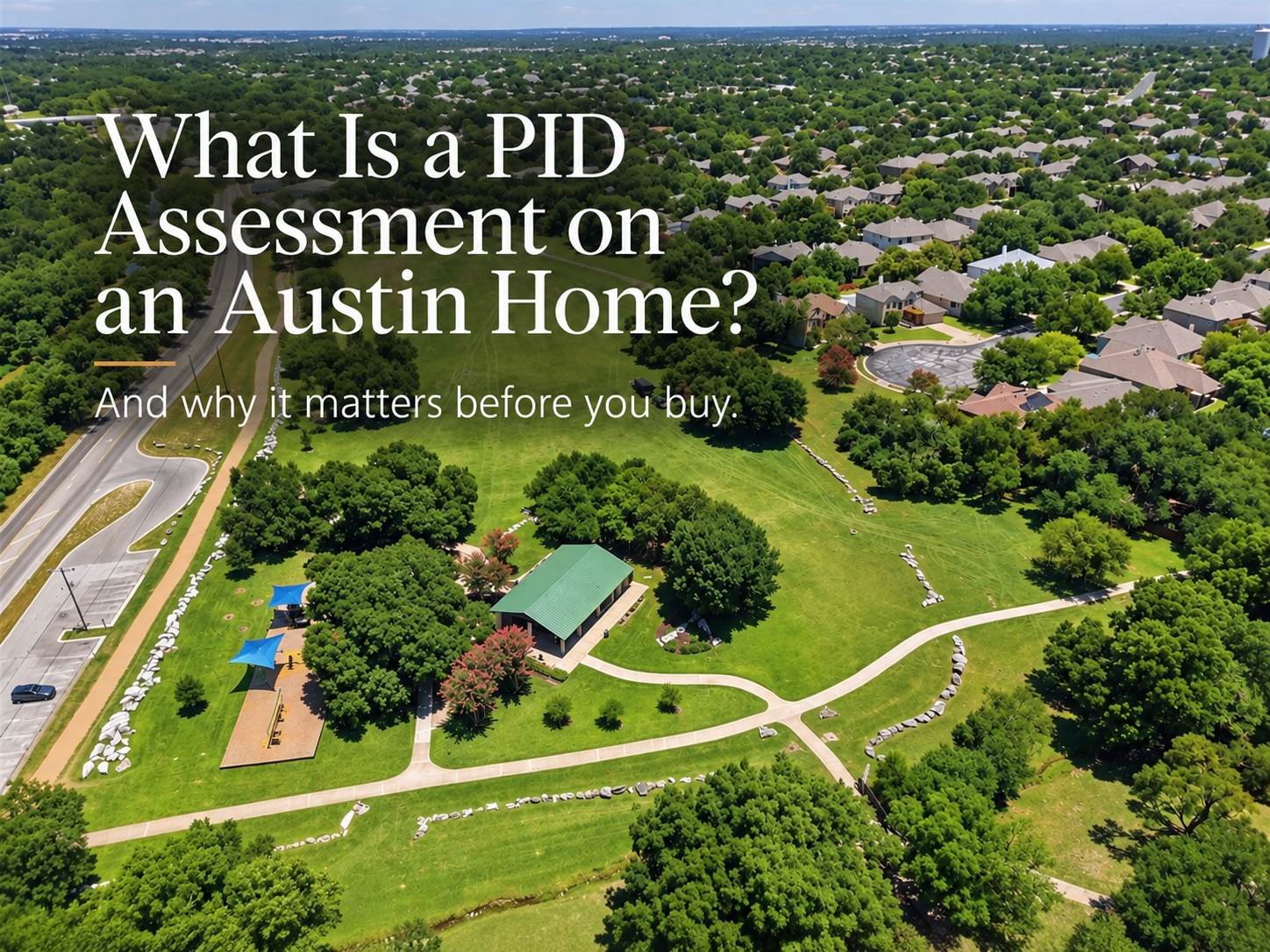
What is a PID assessment on an Austin home?
A PID, or Public Improvement District assessment, is a separate charge that funds the roads, parks, lighting, or drainage in a newer Austin-area development, and it shows up on your property tax bill in addition to your regular property taxes. Texas Property Code Section 5.014 requires the seller to disclose it in writing before you sign a contract. The assessment typically runs 20 to 40 years, or until the district’s bonds are paid off, and on a $450,000 home it can add several hundred dollars a year to your real carrying cost. Unlike an HOA fee, you can’t opt out of it, and it transfers with the property when you buy.
Last updated October 2026
If you’ve been house hunting in the newer pockets of the Austin metro, you’ve probably seen a line item buried in a listing or a closing disclosure that you’ve never had to think about before: a PID assessment. Most buyers find out what it means at the title company, three weeks before closing, when it’s too late to easily walk away without losing momentum on the deal.
That’s backward. This is something you should know before you write the offer, not after.
What a PID actually pays for
A Public Improvement District is a defined area, usually a new subdivision or a section of a mixed-use development, where the city or county lets a developer fund neighborhood infrastructure up front and pay it back over time through an assessment on every property inside the district. It’s created under Texas Local Government Code Chapter 372.
The money typically covers things like:
- Roads, sidewalks, and street lighting inside the development
- Parks, trails, and shared green space
- Entry monuments, landscaping, and irrigation systems
- Drainage and stormwater infrastructure
- Ongoing maintenance of the shared improvements above
In practice, a developer builds these amenities first, often financed through bonds, and then the PID assessment is how homeowners in that district repay the cost over the following decades. It’s the reason a brand-new development can open with finished parks and landscaped entries on day one instead of waiting years for the city to fund them.
How much a PID assessment actually costs you
The rate is usually set as cents per $100 of your home’s assessed value, and it’s billed alongside your property taxes, not folded into them. A common structure looks something like 15 cents per $100 of value. On a $400,000 home, that works out to roughly $600 a year, on top of your normal Travis County property tax bill.
That number sounds manageable in isolation. The part that catches buyers off guard is the duration. PID assessments typically run 20 to 40 years, or until the bonds that funded the improvements are paid off. You’re not paying it for a season while the neighborhood finishes build-out. You’re paying it for close to the life of your mortgage, and it doesn’t disappear when you refinance.
If you’re comparing two similar homes in two different Austin-area developments, a PID assessment is exactly the kind of real cost that should factor into your monthly budget the same way property taxes and insurance do. It rarely shows up in the listing price, and it almost never shows up in a quick online search for “cost of living in Austin.”
PID vs. MUD vs. HOA: they’re not the same thing
Buyers in Austin’s newer developments often run into three different charges that get lumped together in conversation but work completely differently.
A Municipal Utility District, or MUD, provides water, sewer, and drainage service in areas outside the reach of city utilities, and it levies its own tax rate that’s often higher than a standard property tax rate. We’ve written a full breakdown of how MUD taxes work for new construction buyers if you want the detail on that one specifically.
An HOA charges a membership fee to maintain common areas and enforce deed restrictions, and in most cases you have some voice in that organization and some ability to see where the money goes year to year.
A PID is neither. It’s a government-created assessment district tied to the land itself, built to repay a specific set of public improvements, and you have no ability to opt out or cancel it once you own the property. A development can have a PID, an HOA, and sit inside a MUD all at the same time, each charging you separately for a different thing. It’s one more reason the hidden costs Austin buyers overlook deserve a real look before you fall for a floor plan.
What Texas law requires sellers to tell you
Since September 1, 2021, Texas Property Code Section 5.014 has required sellers to give buyers written notice before a contract is finally executed if the property sits inside a PID. Most Texas contracts handle this through a dedicated PID notice addendum, which spells out the assessment amount, the district, and your financial obligation going forward.
There’s a second step, too. At closing, a separate notice with current assessment information has to be signed by both parties, acknowledged, and recorded in the county deed records. Your title company handles that part as it finalizes your closing costs, but it’s not a substitute for getting the notice before you’re under contract.
If a seller doesn’t deliver the required notice in time, you generally have the right to terminate the contract. But if the notice shows up at or before closing and the sale goes through anyway, Texas law treats you as having waived that right. That’s exactly why this is a question to ask your agent before you write an offer, not a surprise to sort out during the option period.
How to check before you write an offer
You don’t have to wait for a disclosure form to find out whether you’re looking at a PID property. A few ways to check early:
- Ask your agent to pull the PID status for the specific address, not just the neighborhood, before you tour it. Boundaries can cut through a development in ways that aren’t obvious from the street.
- Check the Travis County Appraisal District record for the property, which will usually show any special assessment line.
- Ask the builder or listing agent directly for the service and assessment plan, which spells out the annual cost and the payoff schedule.
- Run the full monthly number, mortgage, taxes, insurance, HOA, and PID together, before you fall in love with the floor plan.
None of this means a PID property is a bad buy. Plenty of well-built, well-located Austin-area developments fund their infrastructure this way, and the amenities that come with it are often part of what makes the neighborhood work. It just means the number on the listing isn’t your real monthly cost, and the only way to know for sure what you’re signing up for is to run it with someone who checks this before it becomes a surprise at the title company.
Frequently Asked Questions
Is a PID assessment the same as a property tax increase?
No. A PID assessment is billed separately from your property tax rate, even though it often appears on the same tax statement. It funds a specific set of improvements inside a defined district rather than general city or county services.
Can I pay off a PID assessment early?
In many districts, yes. Some PIDs allow a lump-sum prepayment that removes the annual assessment going forward. Ask the district or your title company about the payoff amount and whether early payment is allowed before you assume it’s locked in for the full term.
Does a PID assessment affect how much mortgage I qualify for?
Yes. Lenders typically include the PID assessment in your debt-to-income calculation the same way they include property taxes and HOA dues. A few hundred dollars a year in PID assessments can shift what you qualify for, so it’s worth flagging early in the pre-approval process.
Will I still be paying the PID assessment if I sell before the bonds are paid off?
No, once you sell, the PID assessment transfers with the property to the new owner. But you’re required to disclose it to your buyer the same way it was disclosed to you, and your listing agent should confirm the current balance and payoff schedule before the home goes on the market.
How do I find out if a specific Austin-area home has a PID?
Your real estate agent can check the property against Travis County appraisal records and the relevant city or county’s PID registry before you ever schedule a showing. This is a five-minute check that can save you from a surprise three weeks before closing.
If you’re weighing a newer Austin-area development against a resale home and want to know exactly what you’d be signing up for long term, we’d love to help. Reach out anytime at munozaustin.com/connect.